
(1 minute read)
Question:
Hi, Devora. I attended your workshop recently, and it was fantastic. However, I cannot see myself doing this with teenagers. I’m a little confused about how you present this to teens and why they would respond to such a system. To me, it seems to be too childish.
Answer:
Thank you for this question, because it’s asked of me often. Many people assume Red Green Behavior Therapy is only for younger children, and they can’t imagine teenagers taking it seriously. But there are two key reasons why the system works beautifully with teens—and even young adults.
First, when I meet with a teenager, I often ask, “Do you speak the Red and Green language?”
Their typical reaction is a confused look—Huh? What are you talking about? That becomes my entry point. I explain, “Let me show you. I speak this language sometimes, and I might slip into it by mistake. If I do, you’ll understand what I am talking about.”
Then I show them a small, mature-looking sketch of a traffic light:
- Red = stop these behaviors
- Green = keep doing these behaviors—these are working
- Yellow = slow down and notice your feelings
This becomes a clean, simple code we both understand. And I tell them, “If I ever mention a ‘red’ or a ‘green’ and you are confused, remember this.”
Learning a new “language” feels cool. This introduction comes across as efficient and respectful, not childish.
Second, the vocabulary changes with the client’s age and ability.
A five-year-old gets simple behavioral language.
A sixteen-year-old with sophisticated verbal skills gets a list that matches their maturity, intelligence, and expressive ability.
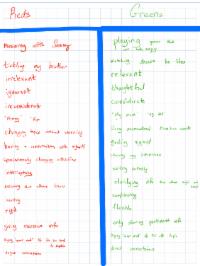
For example, in my iPad, I created the list above for a 15-year-old young man who was extremely bright but struggled socially. Because he was exceptionally verbal and well-read, his Red and Green list was written in language that fit his level. He did not see the system as childish. In fact, he saw it as a structured, logical way to break down the social goals he wanted to work on.
In short, that’s why the system works for teenagers.
It’s not the colors or visuals that determine how the teen will respond —it’s the shared language, the customized vocabulary, and the respect embedded in the process. When teens feel spoken to respectfully and on their level, they respond.
Have a productive and creative week!
Yours,
Dr. Devora