
(1 minute read)
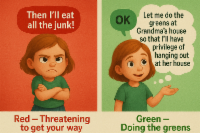
In a recent session, I spoke with one of my moms about her 5-year-old daughter, Sarah. Although Sarah had made great progress on Friday nights after her mom implemented the Friday Night Plan, Saturday mornings were still a challenge.
So I presented another plan — simple and clear: if Sarah gets wild and doesn’t follow the Shabbat meal rules at Grandma’s house around the corner, she’ll eat the meal at home for a few weeks—until she feels ready to respect Grandma’s rules. Of course, an adult would stay with her to make sure she’s safe. We also decided to make a mini-book about the reds and greens of spending Shabbat meals at Grandma’s, so Sarah would be crystal clear about the expectations there.
Without missing a beat, Sarah piped in, “Well, then I’ll eat all the junk in my house.”
Mom sighed. “See what I mean? I don’t know what to do!”
Me (in a calm, steady voice): “Oof. That’s threatening. And threatening is red. Let me draw a picture of that red and green.”
I asked Sarah to pose for a picture with her angry face, and she readily agreed. I added a red speech bubble with her words: “Well, then I’ll eat all the junk in my house.” Then I asked her to pose again, this time with a pleasant, thoughtful look. In the green speech bubble, I wrote, “Let me do the greens at Grandma’s house so that I’ll have the privilege of hanging out at her house.”
Sarah loved the picture, which we printed out immediately. And once again, the red-green language turned a tricky moment into a teachable one.
The reason this works is that, ultimately, Mom didn’t get pulled into an argument or react as if she were intimidated by the threat. Instead, by calmly naming the red behavior, we sent a clear message: We see the tactic, and it won’t work anymore.
Have a calm green week!
Yours,
Dr. Devora